

How do you know whether your security guards are performing well?
Showing up for a shift is important, but it does not tell the whole story.
A guard may arrive on time but miss patrol checkpoints. Another may complete every patrol but submit reports late. A third may consistently follow procedures, respond quickly, and keep accurate records.
Without the right security guard performance metrics, these differences can be difficult to see.
That is why security companies need to look beyond basic attendance and measure the activities that directly affect coverage, accountability, productivity, and service quality.
The right security guard KPIs give managers a clearer way to recognize strong performance, identify recurring gaps, coach guards where improvement is needed, and make better workforce decisions.
With GuardsPro, managers can use guard analytics and operational records to review information such as tours completed, tasks completed, reports submitted, idle alerts, no-shows, and hours worked. Attendance, patrol, checkpoint, and other reports provide additional performance context.
Why Measure Security Guard Performance?
Security work happens largely in the field, often across multiple locations and outside direct supervisor view.
That makes performance difficult to evaluate based on observation alone.
A structured approach to guard performance monitoring helps replace assumptions with operational data.
Instead of asking whether a guard “seems reliable,” managers can look at whether they regularly arrive on time. Instead of assuming patrols are being completed, they can review actual tour and checkpoint activity. Instead of discovering reporting problems after a client complains, they can monitor whether required reports are being submitted consistently.
Performance metrics also make reviews fairer.
When guards are evaluated against clear expectations and consistent data, managers have a stronger basis for recognizing high performers and addressing recurring problems.
So, what should you measure?
10 Security Guard Performance Metrics Worth Tracking
1. Attendance and Punctuality
Reliable security coverage begins with guards showing up when and where they are scheduled.
Attendance is therefore one of the most fundamental security guard performance metrics.
Managers should monitor how consistently guards report for assigned shifts on time and look for repeated late arrivals or attendance issues.
One late arrival may not indicate a larger problem. A pattern of late starts across several shifts, however, deserves attention.
With GuardsPro’s Scheduler, managers can review guard attendance, check-in and check-out times, shift duration, and assigned post sites, helping them compare actual attendance with scheduled coverage.

2. No-Show Rate
A late guard creates a problem. A guard who never arrives can leave an entire post uncovered.
That makes no-shows an important KPI for both security officer performance and overall workforce reliability.
Managers should monitor how frequently guards miss scheduled shifts and whether the same problem continues over time.
A rise in no-shows should not automatically be treated as an individual guard issue. Managers should also look for patterns around particular sites, schedules, shift times, or workload conditions.
GuardsPro Analytics includes no-shows among the information administrators can review when evaluating guard activity and performance.

3. Patrol Completion
For guards responsible for conducting patrols, being present at the property is not enough.
The required tours still need to be completed.
Patrol completion helps managers understand how consistently guards complete the site tours assigned to them during their shifts.
Repeated missed or incomplete tours can indicate that something needs attention, whether that is guard performance, unclear patrol requirements, scheduling problems, or unrealistic workloads.
With GuardsPro, site tour reports can show completed, missed, and pending tours along with guards, post sites, start and completion times, and checkpoint activity.
That gives supervisors a clearer view of whether patrol requirements are actually being followed.

4. Checkpoint Compliance
A completed tour does not always mean every required area was checked.
That is why checkpoint-level performance deserves attention as well.
Checkpoint compliance helps supervisors see whether guards are consistently visiting the checkpoints required as part of their patrol routes.
If the same checkpoints are repeatedly missed, managers can investigate why.
The issue could be guard performance, unclear instructions, unrealistic patrol timing, accessibility problems, or even the way the tour itself has been designed.
GuardsPro Tour Checkpoint Logs provide scan timestamps, guard and post-site information, GPS location data, notes, and checkpoint details, while Site Tour Reports can help identify missed checkpoints.

5. Task Completion
Security guards often perform much more than routine patrols.
Depending on the site, they may be required to inspect doors, check equipment, complete opening or closing procedures, monitor specific areas, or carry out other assigned tasks.
Tracking task completion helps managers understand whether this work is being completed consistently.
But the number of completed tasks should not be viewed in isolation.
A guard completing several simple tasks cannot automatically be considered more productive than someone completing fewer but more demanding assignments.
Site responsibilities, task complexity, shift conditions, and workload should all be considered when evaluating security guard productivity.

6. Report Submission and Reporting Quality
A guard may perform excellent work in the field, but if important activity is not documented properly, managers and clients may have little visibility into it.
Reporting is therefore an important performance measure.
Managers should monitor whether guards submit required Daily Activity Reports, hourly reports, incident reports, checklists, and other site-specific documentation consistently and on time.
GuardsPro provides operational reporting across areas such as DARs, incidents, site tours, tasks, checklists, and other standard or custom reports. Its Guard KPI Report can also provide insights across several of these report types.
Quantity should not be the only consideration.
Good reporting also means the information submitted is complete, accurate, relevant, and useful.
A guard who submits every required report but repeatedly leaves out important details may still need additional guidance or training.

7. Incident Response and Escalation
Security guards are often expected to identify issues, document incidents, and escalate situations according to company and client procedures.
One useful security operations metric is how effectively guards handle these events.
Managers should consider how quickly incidents are reported, whether the appropriate people are informed, whether established protocols are followed, and whether the documentation clearly explains what happened. The right tools and processes can also help teams improve incident response times and protocols by supporting faster reporting, communication, coordination, and follow-up.
The goal is not to assume that fewer incident reports mean better performance.
A guard working at a higher-risk location may naturally encounter and report more incidents than someone assigned to a quieter property.
Instead, focus on how incidents are handled.
Was the issue communicated promptly? Was the correct action taken? Was the incident documented clearly? Were established procedures followed?
Those questions provide a much more meaningful picture of performance.

8. Idle or Inactivity Alerts
Security work can include quiet periods where nothing unusual happens. That does not automatically mean a guard is inactive or performing poorly.
But repeated, unexplained inactivity during periods when patrols or other duties should be taking place may deserve attention.
Idle alerts can help managers identify these situations.
Rather than treating every alert as a performance failure, supervisors should look for patterns.
Does the same guard regularly generate inactivity alerts during expected patrol periods? Is the pattern different from other guards working similar posts? Is there a reasonable operational explanation?
GuardsPro Guard Analytics includes idle alerts alongside other guard activity indicators, giving managers another source of information when reviewing performance over time.
9. Geofence and Site Compliance
Clocking in does not always tell a manager whether a guard is where the assignment requires them to be.
Location-based information can provide additional context.
With geofencing, companies can define virtual boundaries around post sites and review relevant guard entry and exit activity.
This makes site compliance another useful area to monitor.
Managers can look for repeated situations where guards leave assigned areas unexpectedly or where location information does not align with scheduled duties.
Context still matters. A guard may have a legitimate operational reason for leaving a designated area.
Geofence information should therefore help managers identify situations worth reviewing rather than automatically determining whether a guard performed well or poorly.

10. Hours Worked and Schedule Compliance
Managers should also compare how guards actually work with what was originally scheduled.
Consistently working fewer hours than expected may indicate attendance or scheduling problems. Consistently working unusually long hours may point to understaffing, overtime dependence, uneven workloads, or other operational issues.
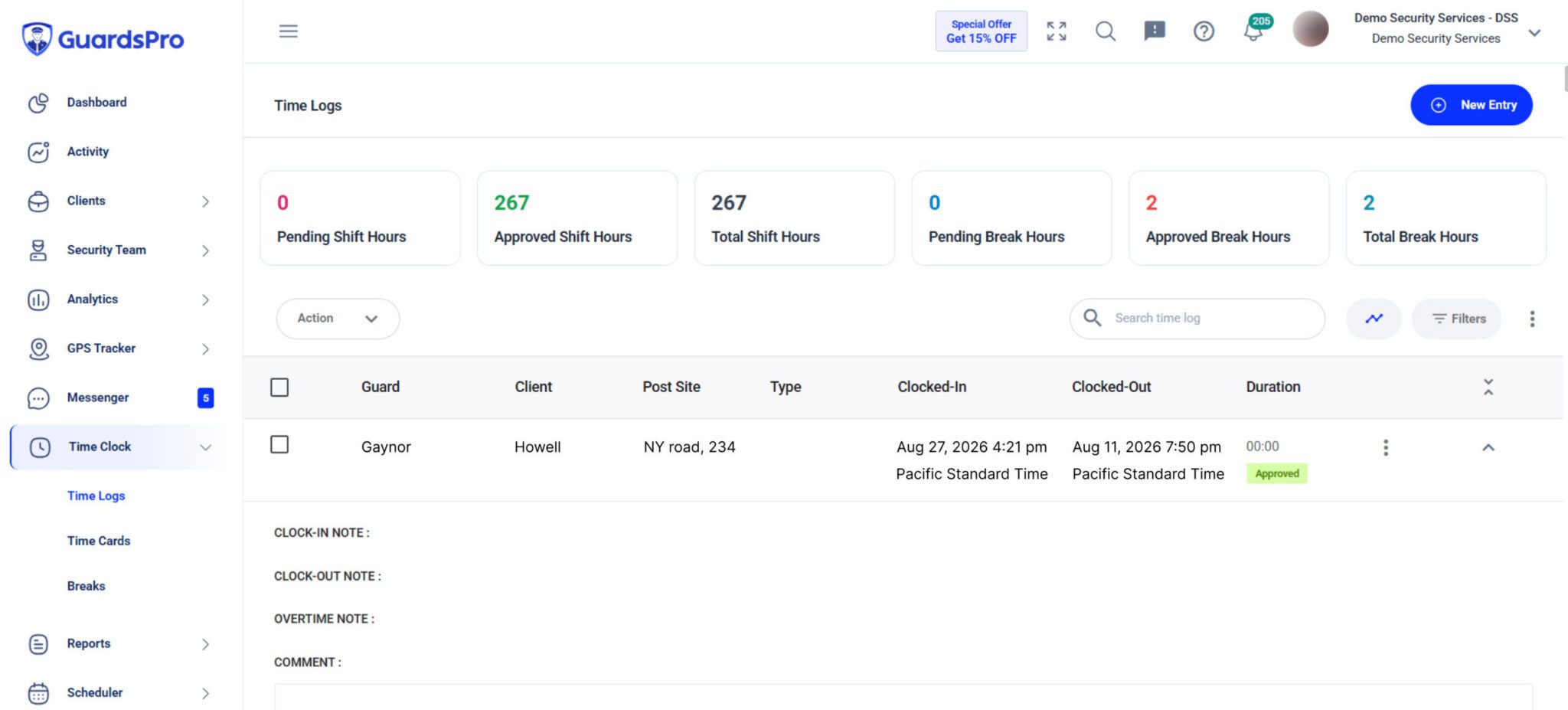
GuardsPro provides time-log and guard activity information that can help managers review working hours alongside other performance data.
Looking at hours worked together with other security workforce KPIs provides important context.
For example, lower patrol activity from a guard who has been working unusually long shifts may require a different response than the same performance pattern from someone working a normal schedule.
Don’t Measure KPIs in Isolation
A common mistake in performance management is allowing one number to tell the entire story.
Security operations are more complicated than that.
A guard with more incident reports may simply work at a more challenging site. A guard with fewer completed patrols may have been handling an incident. More hours worked do not necessarily mean greater productivity. One missed checkpoint does not automatically indicate poor performance.
That is why the best approach is to look at security guard performance metrics together.
Attendance shows whether guards are reporting for duty reliably. Patrol and checkpoint activity helps managers understand whether required rounds are being completed. Tasks and reports provide visibility into assigned work and documentation. Location information adds site context, while hours worked help explain workload.
Combined, these metrics create a much more useful picture than any single KPI.
Measure Security Guard Performance With GuardsPro
Managing performance becomes difficult when attendance lives in one system, patrol records in another, reports somewhere else, and supervisors rely on memory to connect everything.
GuardsPro brings many of these operational records into one security guard management platform.
Guard Analytics can help managers review information including tours completed, tasks completed, reports submitted, idle alerts, no-shows, and hours worked. Guard KPI reports provide additional insights across standard reports, incident reports, site tours, tasks, and checklists.
Combined with attendance reports, patrol records, checkpoint logs, GPS tracking, geofencing, and other field activity, managers can build a clearer picture of security officer performance without relying entirely on manual supervision.
The goal is not to track more data for the sake of it.
It is to know where performance is strong, where gaps are forming, and where managers should take action.
The Bottom Line
Good security guard performance is not defined by a single number.
It is reflected in whether guards show up reliably, complete assigned duties, follow patrol requirements, document their work, remain accountable at their sites, and respond appropriately when something happens.
Tracking the right security guard performance metrics helps security companies turn those expectations into something managers can actually review and improve.
Focus on patterns rather than isolated events. Look at multiple KPIs together. Compare guards performing similar roles and working under similar conditions. And always consider the operational context behind the data.
With a clearer view of performance, managers can spend less time guessing how their teams are doing, and more time helping them perform better.
Improve Guard Performance Visibility With GuardsPro
GuardsPro helps security companies connect guard performance with the operational activity behind it, from attendance and patrols to reports, tasks, tracking, and workforce data.
Use clearer performance information to strengthen accountability, identify coaching opportunities, and maintain more consistent service across your security operation.
Start your free 30-day trial of GuardsPro today and see how a more connected scheduling process can simplify everyday operations.
Sign up within 15 days to unlock an exclusive 15% discount on your subscription.
Have questions or feedback? Get in touch anytime.
FAQs
What are security guard performance metrics?
Security guard performance metrics are measurable indicators used to understand how consistently guards meet operational expectations. Common areas include attendance, punctuality, patrol completion, checkpoint compliance, task completion, reporting, no-shows, site compliance, and hours worked.
What KPIs should a security company track?
Important security guard KPIs include attendance and punctuality, no-shows, patrol completion, checkpoint compliance, task completion, reporting quality, incident handling, inactivity patterns, site compliance, and hours worked.
How do you measure security guard productivity?
Security guard productivity can be evaluated by reviewing patrols, tasks, reports, attendance, working hours, and other assigned activities. These should be considered together and within the context of the guard’s site, shift, and responsibilities.
How often should security guard performance be reviewed?
Performance can be monitored regularly as part of daily operations, while broader reviews can focus on trends over time. Looking at recurring patterns usually provides a more useful picture than judging a guard based on one shift or incident.
Can security guard software track guard KPIs?
Yes. Security management software can use attendance, patrol, task, reporting, location, and workforce information to support guard performance monitoring. GuardsPro provides Guard Analytics and Guard KPI reporting alongside other operational records.
Why are security workforce KPIs important?
Security workforce KPIs help managers identify performance patterns, recognize strong work, uncover training opportunities, improve staffing decisions, and find areas where operational processes may need attention.