
A visitor becomes aggressive after being denied entry. Two employees start arguing at a warehouse. A trespasser refuses to leave a commercial property.
For security guards, these situations can escalate quickly. How a guard responds in the first few moments can influence whether a disagreement settles down or turns into a dangerous confrontation.
Not every tense interaction requires physical intervention. In many situations, calm communication, situational awareness, and appropriate boundaries can help reduce tension before violence occurs.
However, de-escalation is not about winning an argument or forcing someone to cooperate. It is about reducing the risk of harm while protecting everyone involved.
This guide covers 10 practical de-escalation techniques for security guards, warning signs of potential violence, common mistakes to avoid, and the responsibilities of supervisors when a confrontation occurs.
What is de-escalation in security?
De-escalation is the use of communication and other nonphysical techniques to reduce tension during a potentially hostile or violent situation.
For security guards, this may involve listening to an upset visitor, explaining an access restriction, giving someone time to calm down, or requesting assistance before an encounter becomes unsafe.
The goal is to prevent unnecessary confrontation while maintaining the security requirements of the property.
Effective de-escalation generally involves four activities:
- Recognize: Identify behaviors that may indicate an escalating conflict.
- Assess: Determine the level of risk and whether engaging is safe.
- De-escalate: Use appropriate communication and nonthreatening actions to reduce tension.
- Report: Notify the appropriate personnel and document significant incidents.
This approach aligns with guidance from the Cybersecurity and Infrastructure Security Agency (CISA).
Not every confrontation can be resolved through conversation. If someone becomes physically violent or presents an immediate threat, guards must follow their emergency procedures, seek safety, and request appropriate assistance.
How to recognize warning signs of a violent confrontation
Before attempting to calm a situation, security guards need to recognize when tension is increasing.
Some observable warning signs include:
- Shouting, repeated verbal threats, or increasingly hostile language
- Invading another person’s personal space
- Clenching fists or making threatening gestures
- Striking walls, furniture, or other objects
- Blocking someone from leaving
- Attempting to push, grab, or strike another person
- Displaying or threatening to use a weapon
These behaviors must be evaluated in context. An angry tone, nervous appearance, or unusual behavior alone does not prove that someone intends to become violent.
Guards should avoid assumptions based on a person’s appearance, disability, background, or perceived emotional condition.
Instead, focus on specific actions, the surrounding environment, and whether anyone faces an immediate risk of injury.
For example, a visitor complaining loudly about an access rule requires a different response from someone threatening to assault an employee.
Understanding that distinction helps guards decide whether to communicate, request backup, or move to safety.
10 de-escalation techniques every security guard should know
1. Stay calm and control your own reactions
A guard’s tone and body language can influence the direction of an encounter.
Responding to shouting with more shouting often makes communication harder. Even when someone is rude or insulting, guards should maintain a professional demeanor.
Speak at a steady pace, use clear language, and avoid making the interaction personal.
For example, instead of saying:
“Stop yelling at me. You’re making things worse.”
Try:
“I want to understand what’s happening. Let’s talk so we can work out the next step.”
The second approach acknowledges the situation without starting another argument.
Remaining calm does not mean ignoring threats. If the person’s behavior indicates immediate danger, prioritize safety rather than continuing the conversation.
2. Maintain a safe distance and awareness of exits
Personal space matters during a heated interaction.
Standing too close can make someone feel challenged or trapped. It can also leave the guard with less time to respond if the situation becomes physical.
When practical, maintain a comfortable distance and avoid unnecessary physical contact.
Pay attention to the environment, including:
- Nearby entrances and exits
- Other employees, visitors, or bystanders
- Objects that could create a safety hazard
- Confined spaces where movement may be restricted
- Whether assistance is available
Avoid positioning yourself where you could become trapped.
If it is no longer safe to remain in the area, disengage and follow the site’s emergency response procedures.
3. Use active listening to understand the problem
An upset individual may feel frustrated because they believe nobody is listening.
Active listening can help identify the issue without agreeing to unreasonable or unsafe demands.
Let the person explain their concern when it is safe to do so. Avoid interrupting unnecessarily, and ask short questions to clarify what happened.
Useful phrases include:
“I understand that you’re frustrated.”
“Can you tell me what happened?”
“Let me make sure I understand the issue.”
Suppose a delivery driver becomes upset because security cannot allow entry without authorization.
Rather than repeatedly saying that the driver cannot enter, the guard can acknowledge the concern and explain the next step.
“I understand that you’re trying to complete your delivery. I need to confirm your authorization before I can let you through.”
Listening does not require changing security rules. It helps the guard communicate those rules without unnecessary confrontation.
4. Use open and nonthreatening body language
Communication involves more than words.
A clenched jaw, pointing finger, aggressive gestures, or sudden movements may increase tension even when a guard’s words are calm.
When safe and appropriate:
- Keep your hands visible and relaxed.
- Avoid pointing directly at the person.
- Maintain a neutral facial expression.
- Use controlled, deliberate movements.
- Avoid staring aggressively.
- Respect personal space.
Body language should communicate professionalism and awareness rather than intimidation.
Remember that eye contact, gestures, and personal space can have different meanings across individuals and cultures.
The priority is to remain attentive without creating an unnecessary confrontation.
5. Acknowledge emotions without agreeing to unsafe behavior
People are sometimes more willing to cooperate when they feel their concerns have been acknowledged.
A guard can recognize someone’s frustration without approving threats, aggressive behavior, or policy violations.
For example:
“I understand that this delay is frustrating. I can explain the entry process, but I can’t allow anyone through without authorization.”
This response combines empathy with a clear operational boundary.
Avoid sarcastic comments, dismissive language, or telling someone that their feelings are unreasonable.
Also avoid making promises you cannot keep.
If you cannot authorize entry, waive a restriction, or resolve a complaint yourself, explain what you can do instead.
6. Offer clear and reasonable choices
Giving someone a limited number of safe options can reduce the feeling that they are being forced into a confrontation.
For example, a visitor without authorization might be offered the following choices:
“We can contact your host to confirm access, or you can return once your authorization is approved.”
Both options maintain the site’s security requirements.
When offering choices:
- Keep the options simple.
- Explain them clearly.
- Make sure they comply with site policy.
- Avoid presenting threats as choices.
- Do not offer alternatives you are not authorized to provide.
The purpose is to help the person understand a safe path forward.
7. Avoid arguments, insults, and power struggles
Security guards must enforce rules, but they do not need to win every disagreement.
Arguments can become personal when a guard feels challenged or disrespected.
Avoid statements such as:
“You have to listen because I’m security.”
“If you don’t like it, that’s your problem.”
“I don’t care what you think.”
Instead, return the conversation to the specific policy or next step.
For example:
“This area is restricted to authorized personnel. I can help you contact the person responsible for access.”
Keep your explanation brief. Repeating the same demand more aggressively usually does not improve cooperation.
If the person continues making threats or becomes increasingly hostile, request assistance rather than prolonging the exchange.
8. Give the person time and space when safe
Not every disagreement needs to be resolved immediately.
Allowing a brief pause can help reduce the pressure of an emotionally charged interaction.
If someone is upset but not presenting an immediate danger, avoid demanding an instant response.
You might say:
“I can give you a moment. When you’re ready, we can discuss the next step.”
In some cases, involving a supervisor or moving the discussion to a quieter, appropriate location may help.
However, do not move to an isolated space with a potentially violent individual or allow yourself to become trapped.
Use time and space only when doing so is safe and consistent with the property’s procedures.
9. Know when to disengage and request backup
One of the most important de-escalation skills is recognizing when communication is no longer appropriate.
Security guards should not continue a conversation simply to prove they can control the situation.
Warning signs that immediate assistance may be necessary include:
- Direct threats of physical violence
- Attempts to strike or grab someone
- A weapon being displayed or used threateningly
- Escalating aggression despite attempts to calm the situation
- A person blocking exits or preventing others from leaving
- Any situation that places guards or bystanders in immediate danger
Where safe, create distance, move others away from danger, and notify the appropriate emergency responders.
Call 911 in the United States when there is an immediate threat requiring emergency assistance. Follow the site’s emergency communication plan as well.
Do not attempt physical intervention unless it is lawful, necessary, consistent with your training, and within your assigned authority.
A safe withdrawal and timely request for help can be the most appropriate response.
10. Document the confrontation and follow up
A confrontation does not necessarily end when the people involved leave the area.
Supervisors may need to review what happened, respond to complaints, adjust procedures, or coordinate additional safety measures.
Guards should report significant incidents according to site policy.
An accurate incident report should include:
- Date, time, and location
- People involved, where identification is appropriate and available
- Specific threatening or aggressive behavior observed
- Relevant statements, using exact words when possible
- Actions taken to reduce tension
- Assistance requested and personnel notified
- Whether anyone was injured
- Final outcome and any unresolved concerns
Focus on facts instead of assumptions.
For example, rather than writing:
“The visitor was crazy and dangerous.”
Write:
“The visitor raised his voice, struck the reception counter twice, and stated, ‘I’m coming back to deal with this.’ The guard notified the site supervisor.”
The second description provides useful information for follow-up without making unsupported judgments.
What should a security guard do when de-escalation fails?
Sometimes a person will not respond to verbal de-escalation.
A guard’s next action should depend on the level of danger, the site environment, and the emergency procedures established by the employer.
| Situation | Appropriate general response |
|---|---|
| Person is upset but not threatening | Continue calm communication if safe |
| Person refuses to comply with a site policy | Explain available options and involve a supervisor when needed |
| Person makes credible threats or behaves aggressively | Create distance, warn others as appropriate, and request help |
| Physical violence is occurring or imminent | Prioritize safety, follow emergency procedures, and contact emergency services |
| Situation has ended | Check for injuries, notify the appropriate personnel, preserve relevant information, and submit a report |
The presence of a uniform does not eliminate the risk of injury or automatically grant law-enforcement authority.
Security guards should never assume that every confrontation can be controlled through verbal techniques.
Real-world examples of security guard de-escalation
Understanding these techniques becomes easier when you consider situations guards encounter during everyday assignments.
Scenario 1: An angry visitor at a corporate building
A visitor arrives without an appointment and demands access to a restricted floor. The visitor becomes angry when the security guard refuses entry.
Recommended approach:
The guard keeps a calm tone, explains the access requirement, and offers to contact the relevant employee or department.
The guard does not make personal comments or argue about the policy.
If the visitor becomes threatening, the guard follows the escalation procedure.
Key lesson: Clear communication and reasonable alternatives can help enforce access rules without creating an unnecessary dispute.
Scenario 2: Two employees arguing at a warehouse
During a night shift, two warehouse employees begin shouting at each other near a loading area.
Recommended approach:
The security guard assesses the situation and notifies the appropriate supervisor or response personnel.
If safe, the guard uses calm verbal communication to discourage further confrontation.
The guard avoids physically placing themselves between people who appear ready to fight.
If violence becomes imminent, the guard prioritizes safety and requests emergency assistance.
Once the incident is resolved, the guard documents the events and actions taken.
Key lesson: Early recognition and timely communication are important, but guards should not put themselves at unnecessary risk.
Scenario 3: A person refuses to leave a commercial property
A person remains on a property after being informed of the site’s access restrictions.
The individual is visibly frustrated and repeatedly disputes the instructions.
Recommended approach:
The guard explains the relevant property policy, avoids a personal argument, and provides any safe, authorized alternatives.
If the person continues refusing, the guard contacts the supervisor and follows the established trespass or access-control procedure.
The guard should not use physical force merely because someone is being uncooperative.
Key lesson: Enforcing property rules requires consistent procedures, an understanding of legal authority, and professional communication.
Common mistakes security guards should avoid during confrontations
Several habits can make tense situations more difficult to manage.
Raising your voice to establish authority: Speaking louder may increase hostility instead of improving cooperation.
Making physical contact unnecessarily: Touching, pushing, or grabbing someone can turn a verbal disagreement into a physical encounter.
Taking insults personally: Responding emotionally can distract from the actual security concern.
Ignoring environmental risks: Narrow hallways, blocked exits, nearby traffic, or other hazards can make a confrontation more dangerous.
Trying to handle everything alone: Delaying a request for assistance can increase risk to guards and the public.
Making assumptions about someone’s mental health or intentions: Focus on observable behavior and immediate safety needs rather than attempting a diagnosis.
Failing to document a serious incident: Missing information can make supervisor review and follow-up more difficult.
Security guard de-escalation checklist
Guards and supervisors can use this checklist during training and post-order reviews.
Before a shift
- Review site-specific conflict response procedures.
- Know the supervisor and emergency contact information.
- Identify available communication equipment.
- Understand safe exit routes and emergency procedures.
- Review the limits of your authority and training.
During a confrontation
- Assess the immediate threat before engaging.
- Maintain a safe distance when practical.
- Speak calmly and respectfully.
- Listen without unnecessary interruption.
- Explain boundaries and reasonable options.
- Avoid threats, insults, and unnecessary physical contact.
- Request assistance when the risk increases.
- Disengage if remaining creates immediate danger.
After a confrontation
- Confirm that immediate safety needs have been addressed.
- Seek medical assistance when required.
- Notify the supervisor.
- Document relevant facts and actions.
- Preserve evidence according to company policy.
- Communicate unresolved risks to authorized personnel.
- Participate in follow-up reviews or refresher training when needed.
How security companies can improve de-escalation across multiple sites
For security company owners and operations managers, de-escalation is not just an individual guard skill. It is also a training and operational management responsibility.
Guards assigned to commercial buildings, industrial facilities, construction sites, and residential properties may encounter different types of conflict.
A consistent prevention program should account for those differences.
Establish clear post orders and escalation procedures
Every site should have documented instructions explaining how guards respond to confrontations, who they contact, and when emergency services are required.
A warehouse loading dock, for example, may have different access restrictions and safety hazards than a residential entrance.
Site-specific instructions help guards understand expectations before an incident occurs.
Provide scenario-based training
General advice such as “stay calm” is useful but not sufficient on its own.
Training should include realistic situations involving:
- Access-control disputes
- Aggressive visitors
- Employee disagreements
- Trespassing complaints
- Verbal threats
- Escalating incidents during night shifts
Supervisors can use role-playing exercises to evaluate communication, situational awareness, disengagement, and reporting.
Training should also reinforce the legal limits of private security personnel and applicable use-of-force policies.
Maintain reliable communication with supervisors
When guards encounter a potentially violent situation, they need to know how to obtain support.
Clear communication procedures help supervisors understand the incident, coordinate an appropriate response, and make decisions based on accurate information.
These procedures should be established before an emergency.
Review incident reports to improve procedures
Incident reports can highlight recurring operational concerns.
For example, repeated confrontations at the same entry checkpoint may indicate unclear visitor instructions, inconsistent access procedures, or a need for additional staffing.
Managers should review reported incidents and near misses to identify preventable risks, update post orders, and improve training.
The purpose is not to blame guards for every difficult interaction. It is to make the operating environment safer and procedures more effective.
How GuardsPro supports security incident management
Security guards need clear instructions during their shifts. Supervisors need reliable information about what happened, how an incident was handled, and whether follow-up is required.
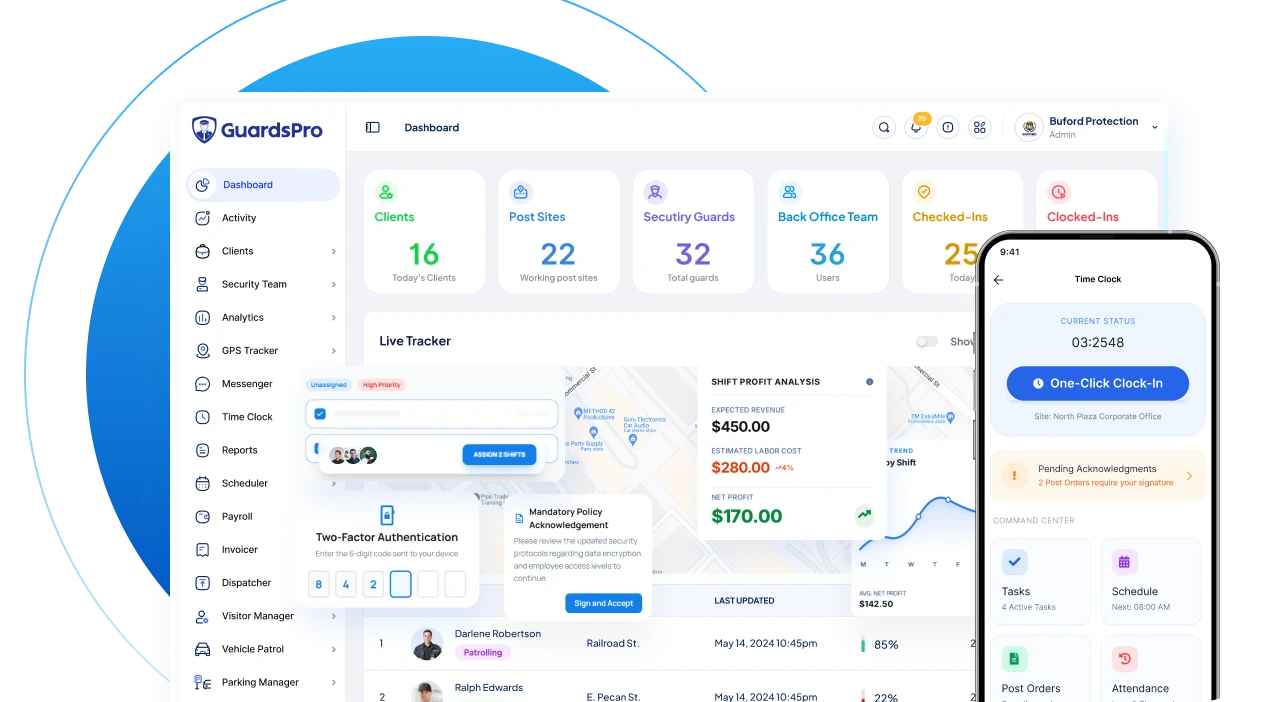
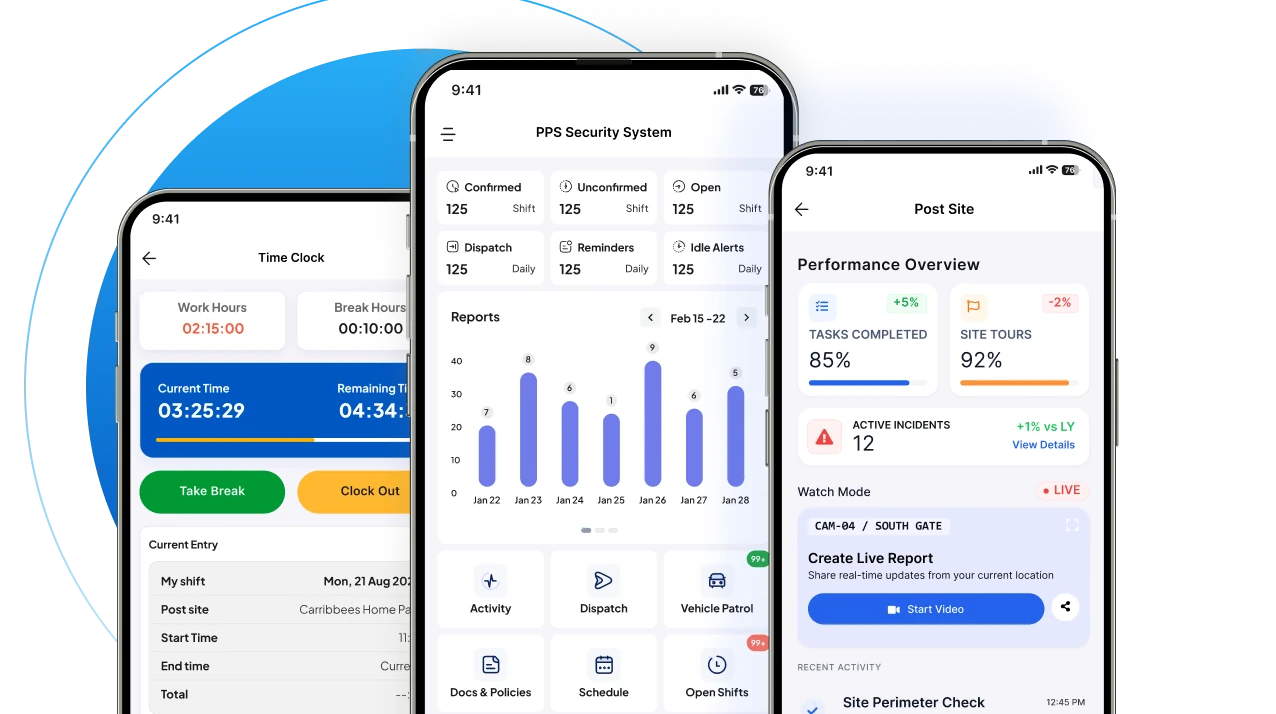
GuardsPro helps security companies organize these operational responsibilities through its security guard management platform.
Site-specific post orders
Supervisors can provide guards with instructions for their assigned sites, including access requirements and escalation procedures. Guards can review updated post orders through the mobile app.
Mobile incident reporting
Guards can submit incident reports from their mobile devices, documenting what occurred and including relevant supporting information.
Supervisor and client visibility
Authorized teams can review incident reports and relevant site activity, making it easier to understand what occurred during a shift and coordinate appropriate follow-up.
These capabilities support communication and accountability. They do not replace de-escalation training, emergency response services, or the judgment of trained security personnel.
For companies managing multiple security sites, keeping instructions and incident records organized helps supervisors provide more consistent operational support.
Frequently asked questions about security guard de-escalation
What are the most effective de-escalation techniques for security guards?
Common techniques include calm communication, active listening, maintaining safe personal space, acknowledging concerns, offering reasonable choices, and avoiding arguments. The appropriate response always depends on the level of risk and whether it is safe to engage.
What should a security guard say to an aggressive person?
Use short, respectful statements that acknowledge the concern and explain the next step. For example: “I understand you’re frustrated. Let me explain what I can do.” Avoid threats, sarcasm, and language that unnecessarily challenges the person.
Can a security guard use physical force to stop a confrontation?
The lawful use of force depends on the jurisdiction, circumstances, guard’s authority, and applicable training and policies. Guards should not assume that verbal noncompliance justifies physical force. They must follow applicable law and company procedures.
When should security guards call the police?
When there is immediate danger, serious violence, a credible imminent threat, or another emergency requiring law enforcement, guards should contact emergency services as soon as it is safe. Nonemergency incidents should follow the site’s established reporting and escalation procedures.
What should be included in a security guard incident report?
Include the time, location, observable conduct, relevant statements, people involved, actions taken, assistance requested, and final outcome. Keep the account factual and avoid speculation.
Why is de-escalation training important for security companies?
Training helps guards recognize potentially dangerous situations, use appropriate communication, understand when to disengage, and follow emergency procedures. It also gives supervisors a consistent framework for reinforcing safer practices.
Final thoughts
Defusing a violent confrontation starts with recognizing that safety matters more than proving authority.
Security guards who communicate calmly, maintain awareness of their surroundings, understand their limits, and request assistance at the right time are better prepared to handle difficult encounters professionally.
For security companies, those skills must be supported by clear post orders, practical training, reliable communication, and accurate incident reporting.
The goal is not to expect every guard to resolve every conflict. It is to equip guards with the procedures and support they need to make sound decisions during every shift.
Give your guards clearer instructions and your supervisors better incident visibility.
Explore how GuardsPro brings post orders, mobile reporting, and security operations together in one platform.
This article provides general security education and does not replace certified de-escalation training, emergency-response protocols, site-specific post orders, or legal guidance. Guards must comply with applicable laws, licensing requirements, and employer policies.