
AI is no longer a distant idea for physical security.
In 2026, security teams are increasingly using artificial intelligence to help review incidents, identify patterns, reduce repetitive work, and bring important information to the surface faster.
That does not mean replacing security guards or supervisors.
Physical security still depends on people making decisions, understanding context, responding on-site, and knowing when a situation requires human judgment. AI is most useful when it helps those people work with information more efficiently.
For security companies, AI in security guard management can support everything from reporting and performance analysis to monitoring and resource planning.
Here are seven practical ways AI is changing the way physical security operations can be managed in 2026.
7 Ways AI Can Improve Security Guard Management
1. Turn Long Reports Into Faster Operational Summaries
Security companies generate a large amount of field information.
Incident reports, standard reports, patrol updates, activity logs, and client documentation can quickly pile up—especially for companies managing several sites.
The problem is not always collecting the information.
It is finding the important part quickly.
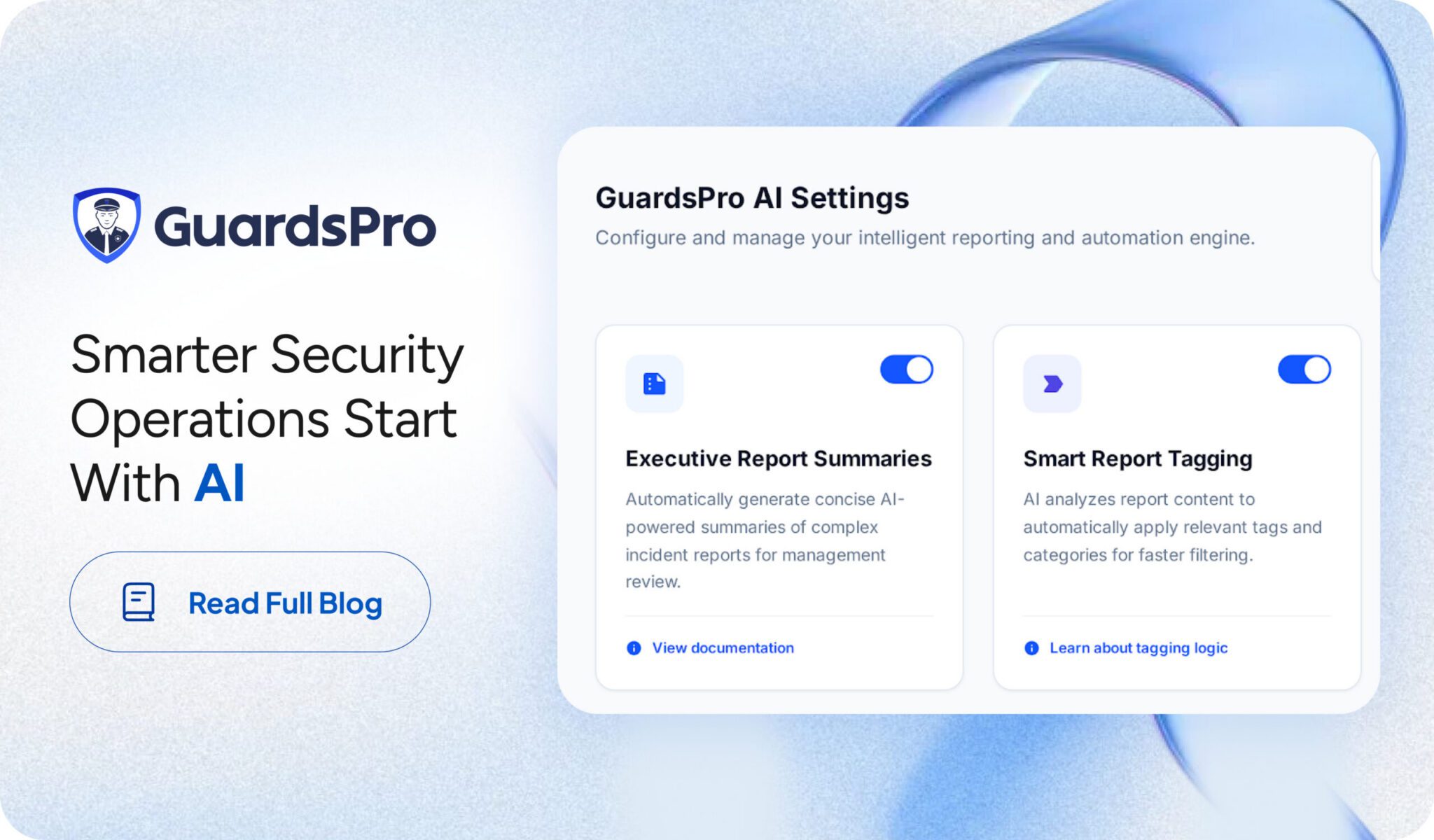
AI-generated summaries can help supervisors review lengthy reports and understand key incidents or activities without reading every line first.
GuardsPro AI, for example, can generate concise summaries of Incident and Standard Reports submitted by guards, helping back-office teams identify important details faster.
This makes AI particularly useful for supervisors reviewing overnight activity, managing multiple locations, or preparing client updates.
Security companies can also explore how GuardsPro Reporting brings field reports into a more centralized reporting workflow.

2. Help Guards Write Clearer Reports From the Field
AI can also support the person creating the report.
Guards often need to document incidents while managing several other responsibilities at the same time. They may know exactly what happened but struggle to phrase the information clearly, especially during a busy shift.
AI writing assistance can reduce some of that friction.
In the GuardsPro Guard Mobile App, AI Assist can rephrase report text to improve grammar, tone, and clarity before a guard submits it.
That does not replace the guard’s observations.
The guard still decides what happened and what information belongs in the report. AI simply helps present that information more clearly.
For field teams, the GuardsPro Guard Mobile App also brings reporting, patrols, schedules, tasks, Post Orders, and other everyday workflows into one mobile experience.

3. Find Patterns Hidden Across Operational Data
One incident may not tell a manager much.
Repeated incidents at the same time, location, or type of site can tell a very different story.
AI and analytics can help security teams work through larger amounts of operational data and identify trends that may be difficult to notice manually.
That could include recurring incident types, repeated coverage issues, patrol patterns, unusual activity, or areas where operational performance is beginning to change.
Avigilon notes that AI systems can analyze large volumes of information, identify patterns, and help security teams focus attention on situations that may require action.
GuardsPro already provides analytics for reports and scheduling data, giving managers graphical views of operational information and guard performance.

You can explore GuardsPro’s broader product information and analytics tools to see how operational data can be brought together for faster review.
4. Help Security Teams Prioritize What Needs Attention
One of AI’s biggest strengths is not simply collecting more information.
It is helping people decide what deserves attention first.
A security manager may be dealing with dozens of reports, alerts, patrol updates, and field activities at the same time. Treating every update as equally urgent creates unnecessary noise.
AI-powered systems can help classify events, identify anomalies, and surface higher-priority activity so operators can focus their attention where it matters most.
This is already becoming common in physical security technologies such as AI video analytics, which can distinguish people, vehicles, objects, movement, and unusual activity instead of requiring operators to continuously watch every camera feed.
For guard management, the same principle matters:
Less time searching through information. More time acting on the information that matters.
The broader GuardsPro feature set includes reporting, analytics, alerts, tracking, patrol tools, and other operational records that help managers maintain a clearer view of activity across their workforce.
5. Support Faster Incident Review and Investigation
After an incident, supervisors often need to reconstruct what happened.
That may involve reviewing reports, timestamps, patrol records, tracking history, video footage, and other activity.
AI can make investigations faster by helping teams search and analyze large amounts of information more efficiently.
In video security, for example, AI-powered search can help operators locate people, vehicles, objects, or unusual events in recorded footage much faster than manually reviewing hours of video.
In guard management, combining clear reports with tracking, patrol, and activity records can provide similar operational context.
GuardsPro brings live field information, reports, site tours, incident records, GPS tracking, and other operational data into its broader guard management system.
That connected approach can help managers build a clearer timeline when something needs to be reviewed.
6. Make Security Operations More Proactive
Traditional security management can easily become reactive.
Something happens. A guard reports it. A supervisor investigates it. Then the company decides what should change.
AI creates opportunities to move some of that thinking earlier.
By identifying recurring patterns, anomalies, or unusual activity, AI-powered systems can help security teams recognize developing risks before they become larger operational problems.
That does not mean AI can predict every security incident.
It means managers can use patterns and historical information to ask better questions:
Why do incidents keep happening at this location?
Why are patrol requirements repeatedly missed during one shift?
Why does the same coverage problem keep returning?
Where should additional supervision or resources be considered?
This shift toward proactive security is one of the major physical-security trends being discussed in 2026. Verkada describes AI as moving physical security from primarily reactive investigation toward more proactive deterrence and response, while Avigilon highlights AI’s ability to analyze real-time information and identify potential threats.
For a broader look at this shift, read GuardsPro’s previously published article Technology Trends Reshaping Security Guard Operations.
7. Help Managers Make Better Workforce Decisions
AI in security guard management is not only about incidents.
It can also support the way security companies manage their workforce.
Managers already work with information such as guard attendance, hours worked, patrol completion, reports submitted, tasks completed, no-shows, and scheduling requirements.
When that information is organized and analyzed effectively, managers can identify performance patterns, staffing gaps, or operational pressure points more easily.
GuardsPro Guard Analytics, for example, provides visibility into tours completed, tasks completed, reports submitted, idle alerts, no-shows, hours worked, and other performance information.
As AI becomes more deeply integrated into security operations, this type of data can increasingly support faster analysis and more informed resource decisions.
The goal should not be to let an algorithm decide which guard is “good” or “bad.”
It should be to give managers better information so they can investigate patterns, understand context, and make the final decision themselves.
GuardsPro’s focus on actionable operational data is also reflected in its security management benefits, including incident management, guard safety, reporting insights, and process automation.
AI Should Support Security Teams, Not Replace Their Judgment
AI can process information quickly.
It can summarize a report, identify patterns, classify activity, and bring unusual events to someone’s attention.
But physical security is full of context.
A guard knows whether an interaction feels unusual. A supervisor understands the risks of a particular client site. An operations manager can consider staffing, training, client requirements, and previous events before making a decision.
AI does not automatically have that full picture.
That is why human oversight remains essential.
Avigilon similarly emphasizes that AI-powered physical security still requires human oversight, ongoing review, and attention to issues such as privacy, data governance, and bias.
The strongest use of AI is therefore not:
AI instead of security professionals.
It is:
AI helping security professionals work through information faster and make better-informed decisions.
What AI Means for Security Guard Management in 2026
AI adoption in physical security is moving quickly, but the value will not come from adding AI simply because the technology is available.
Security companies should start with actual operational problems.
Are managers spending too long reviewing reports?
Are guards struggling to write clear incident documentation?
Is important information buried across too many records?
Are supervisors finding it difficult to identify trends across multiple sites?
Those are the places where AI can provide practical value.
For GuardsPro, AI is already being applied to areas such as report writing and report summaries, while the wider platform provides reporting, analytics, tracking, patrol, scheduling, and workforce information that supports data-driven security management.
The opportunity in 2026 is not to automate every decision.
It is to automate the work that slows people down so security professionals can spend more time on the decisions that actually require them.
The Bottom Line
AI in security guard management is becoming less about futuristic ideas and more about practical operational improvements.
It can help teams summarize lengthy reports, improve field documentation, identify patterns, prioritize information, investigate incidents faster, recognize emerging risks, and make better workforce decisions.
But the human role remains central.
Guards still observe. Supervisors still investigate. Managers still decide.
AI simply helps them get to the information they need faster.
For security companies, that may be one of the biggest opportunities of 2026:
Less time processing information. More time acting on it.
Build Smarter Security Operations With GuardsPro
GuardsPro helps security companies connect field activity with the information back-office teams need to manage operations effectively.
From AI-assisted reporting and AI Report Summaries to analytics, tracking, scheduling, patrol management, and real-time operational data, GuardsPro gives security teams a more connected way to work.
Start your free 30-day trial and explore GuardsPro for your security operation.
Sign up within 15 days to unlock an exclusive 15% discount on your subscription.
Want to see how GuardsPro works for your team? Book a live demo.
Have questions or feedback? Get in touch with GuardsPro.
FAQs
What is AI in security guard management?
AI in security guard management refers to using artificial intelligence to help security companies process operational information, improve reporting, identify patterns, support monitoring, and assist managers with faster decision-making.
How can AI improve security guard reporting?
AI can help summarize long reports and improve the clarity of written information. GuardsPro, for example, offers AI Report Summaries for Incident and Standard Reports and AI Assist to improve grammar, tone, and clarity in guard reports.
Can AI help improve physical security operations?
Yes. AI can help security teams analyze large amounts of information, identify unusual activity, prioritize alerts, improve investigations, and automate repetitive information-processing tasks. Human oversight is still needed to interpret context and make operational decisions.
Can AI replace security guards?
AI can automate or assist with some information-processing tasks, but it does not replace the awareness, judgment, communication, physical presence, and decision-making required from trained security personnel.
How can AI help security managers make better decisions?
AI can help managers summarize information, identify trends, highlight exceptions, and make large amounts of operational data easier to review. Managers can then combine those insights with their knowledge of guards, sites, clients, and operating conditions.
What should security companies consider before adopting AI?
Security companies should begin with a clear operational problem, understand what data the AI system uses, train employees to use it properly, maintain human oversight, and consider privacy, security, accuracy, and data-governance requirements.